
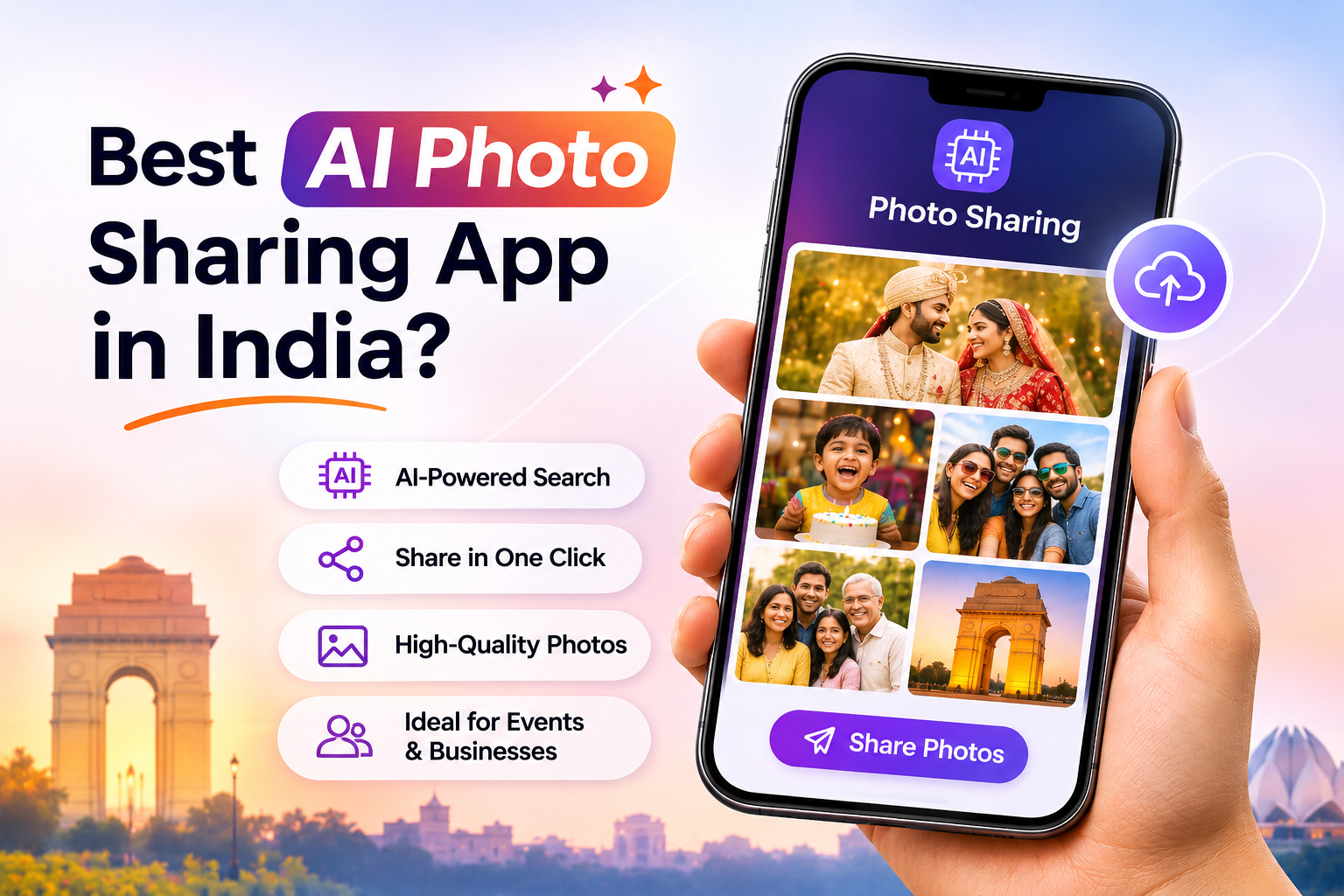
But once you know which of those describes you, the choice gets much easier. Here’s how to work it out.
Why Is There No Single “Best” App for Everyone?
Photo sharing apps in India fall into a few broad groups. Chat apps and cloud storage handle everyday sharing. Some newer apps focus on friends swapping photos with each other. Others are built for events, where one person, usually a photographer, delivers photos to many guests.
Each group solves a different problem. If you search for “the best” without knowing which problem you have, you’ll end up comparing tools that were never meant to compete.
What Should You Look for in an AI Photo Sharing App in India?
A few checks tell you most of what you need to know.
- Face matching: Can guests find their own photos without scrolling through everything? This is the main reason to pick an AI photo sharing app in India users will actually enjoy.
- Easy access: Can someone open the gallery from a link or QR code, without registering for yet another account?
- Phone-friendly galleries: Most people will view photos on a mobile, so it has to feel good there.
- Privacy controls: Look for verification, expiry dates and download settings.
- Workflow fit. If you’re a photographer, can you deliver without redoing your whole process?
- Pricing. Can you try it free before committing?
Think about the usual alternative: a folder with thousands of images and a guest who gives up on page six. With face matching, a guest uploads a selfie and sees the photos they appear in. You share one link, and people find their own pictures.
That’s the biggest shift an online photo sharing app can make for events, and it’s the part worth testing first.
Where Does Pixoye Fit Among Photo Sharing Apps in India?
The Pixoye Photo Sharing App is built for events: weddings, sports meets and other gatherings where one set of photos needs to reach many people. Guests can open a shared gallery without creating an account, and hosts decide whether the whole album is visible or each guest sees only their own face-matched photos.
For photographers, it covers the practical side too. You can send the link by WhatsApp, email, SMS or QR code. You can sync a Google Drive folder instead of uploading twice, and send photos to the cloud during the event so galleries fill up while it’s still going. There’s also an Apple Watch companion that triggers your iPhone camera, and a TV cast option for showing a gallery at a reception or family evening.
If you build albums, the AI story builder picks strong frames, skips duplicates and arranges them in templates, ready to download as a PDF. It’s a useful AI-powered photo sharing platform feature for people who’d rather shoot than lay out pages.
How Does Pixoye Handle Privacy?
Event photos are personal, so access control matters as much as features. Pixoye lets hosts require OTP verification before guests view photos, set expiry dates on galleries and control who can download. That gives you a clear answer when someone asks who can see the album.
What Does It Cost to Try?
Pixoye has a free plan with 1 GB of storage, two active events and up to 1,000 photo uploads. That’s enough to test it on a real event, though not to run a busy season. Paid plans raise those limits and are priced in US dollars on the site, so compare them against how many events you handle in a year.
So, Which App Should You Choose?
A simple sharing app might be sufficient if you want to exchange images with just a small group of acquaintances. However, as a photographer or facilitator of an event, it may be better to use a specialized platform, as its main aim is to let guests locate themselves with no hassle whatsoever.
Whichever you shortlist, test it on something small first, like a birthday or family function. Check how fast the upload is, how well faces match and how the gallery feels on an ordinary phone.
If events are your world, try the Pixoye AI Photo Sharing App in India photographers and hosts can download on iOS and Android, or start at pixoye.com. As their tagline says, “Where Pics Find You.”